How to Book Free Flights With Credit Card Points
This One Is Personal
Yesterday I showed you how to never pay full price for a hotel room. Today, let's talk about the thing I'm most known for: flying free.
I have paid for exactly ONE plane ticket with cash since 2019. One. My son Tanner hopped on a trip at the last minute, and the cash price was so low that it actually made more sense to pay out of pocket and save my points for a bigger redemption later. Every other flight since then — for me, for Brandon, for Tanner and Finn, for my parents, for my best friends — has been free. Paid for with credit card points. We regularly earn 20 to 30 free round-trip tickets a year.
If you told most people that a family could fly 20–30 round-trip flights a year without paying for a single ticket, they'd think you were lying. But you've spent the last 9 days learning exactly how the system works - how to pair cards, capture bonuses, and turn hotel stays into freebies. Now you're about to see where all those points actually GO.
Yesterday was hotels. Today is flights. Together, that's a free trip. And that's been the goal all along.
Heads up — this post contains affiliate links, including links to credit cards I personally use and recommend. If you apply and are approved through my links, I may earn a commission at no extra cost to you. I only recommend cards and tools I genuinely use myself. Thank you for supporting No Point Left Behind!
Two Ways to Turn Points Into Flights
Just like we talked about two paths to free hotels on Day 9, there are two ways to turn your credit card points into plane tickets. One is simple. The other is powerful. Both are legitimate, and there is absolutely a time and place for each.
Path 1: The Travel Portal (The Easy Way)
Every major credit card issuer has its own travel portal — think of it as a built-in booking site, like Expedia or Google Flights, that lives inside your credit card account. Chase has Chase Travel. Amex has Amex Travel. Capital One has Capital One Travel.
Here's how it works:
You log into your credit card account and open their travel portal.
You search for flights exactly the way you would on any travel website.
Instead of paying with your credit card, you "pay" with your points.
Your points are worth a fixed rate — typically 1 cent per point.
A $300 flight costs 30,000 points. A $500 flight costs 50,000 points. Simple math.
Pros: Easy, familiar, no airline loyalty accounts needed. You search, you click, you book. It feels like online shopping. Great for beginners.
Cons: You're getting the minimum value for your points. That's fine sometimes — but once you see what Path 2 can do, you'll understand why I call this the floor, not the ceiling.
Path 2: Transferring to Airline Partners (The Power Move)
This is where it gets exciting. Instead of spending your points through a portal at 1 cent each, you transfer your points directly to an airline's loyalty program — at a 1:1 ratio — and book through the airline's own award system, where those same points can be worth 2 to 5+ cents each.
Let me show you what that looks like in real numbers:
Method
100,000 Points Gets You…Travel Portal (1¢/point)~$1,000 in flights
Airline Transfer (2–5¢+/point)$2,000–$5,000+ in flights
Same points. Dramatically different value.
Pros: Much more value per point, access to premium cabins you'd never pay cash for, ability to book partner airlines all over the world.
Cons: Requires more research, you'll need to create free airline loyalty accounts, and transfers are one-way — once you send points to an airline, you can't send them back.
💡 The Gift Card Analogy
Think of it this way: the portal is like using a gift card at face value. Transferring is like using that same gift card at a store having a 50–80% off sale. Same gift card. Way more stuff. The gift card didn't change — you just got smarter about where you used it.
The Portal — When It Makes Sense
I don't want you to walk away thinking portals are bad. They're not. I use them myself sometimes. Here's when the portal is the right call:
When the portal price is competitive and you don't feel like doing extra research. Sometimes the math is close enough that the convenience is worth it.
When you need a last-minute flight and don't have time to compare award charts and transfer times.
When the cash price of the flight is already low. If the flight is $150 and would cost 15,000 points through the portal, that's perfectly fine — you're not leaving much value on the table.
When you're a total beginner and just want to experience using points for the first time.
That last one matters more than you think. There is something magical about booking your first flight with points. Watching your credit card points turn into an actual plane ticket — seeing that confirmation email land in your inbox — and knowing you didn't spend a dime? That moment is what gets you hooked.
⭐Julie's Advice for Beginners
If you're brand new to this, it’s totally ok to book your FIRST free flight through the portal. Just do it. Don't overthink it. Feel the thrill. Then, once you've got that under your belt, start exploring transfers. You'll be ready — and you'll be hungry for more value.
Transferring Points — Where the Magic Happens
OK, let's get into the good stuff. This is the strategy that turns a good points haul into an extraordinary one. I'm going to walk you through it step by step, because I remember the first time I learned about this — it felt like someone handed me a secret key.
Step 1: Know Your Transferable Points
If you have points in any of these programs, you have transferable points — meaning they can move to airline loyalty programs:
Chase Ultimate Rewards (from cards like the Chase Sapphire Preferred)
Amex Membership Rewards (from cards like the Amex Gold or Platinum)
Capital One Miles (from cards like the Capital One Venture)
Citi ThankYou Points (from cards like the Citi Premier)
If you've been following this series since Day 3 and Day 4, you may already have one or more of these cards in your stack. Those points you've been earning? They're about to become plane tickets.
Step 2: Find the Flight You Want
Start by searching for a flight on Google Flights or directly on the airline's website. Look up the route you want and note the cash price. Write it down — you'll need it for comparison.
Step 3: Check the Airline's Award Availability
Now go to the airline's loyalty program website (you'll need a free account — takes two minutes to create). Search for the same flight, but this time look at the award price — how many miles or points the airline charges to book it through their program.
Some airlines use fixed award charts (a set number of miles per route). Others use dynamic pricing (the miles cost fluctuates like cash prices). Either way, you'll see a number.
Step 4: Do the Math
This is where it gets fun. Divide the cash price by the miles required:
A flight that costs $600 cash or 30,000 miles = 2 cents per point. That's double what you'd get through the portal.
A business class seat worth $3,000 cash for 60,000 miles = 5 cents per point. That's five times the portal value.
Compare that to the portal, where those same points are worth 1 cent each. The difference is staggering.
Step 5: Transfer and Book
Once you've confirmed the award seat is available and the math is in your favor, go to your credit card account, find the transfer partners section, and move your points to the airline. Transfers are usually instant or take just a few hours. Then book the flight through the airline's website using your newly transferred miles.
The first time you book a flight worth $800 using 30,000 points that you could have spent on a $300 portal booking, you'll never go back. Trust me on this one.
Who Transfers Where?
Here's a quick look at some of the major airline transfer partners for each program — all at a 1:1 ratio:
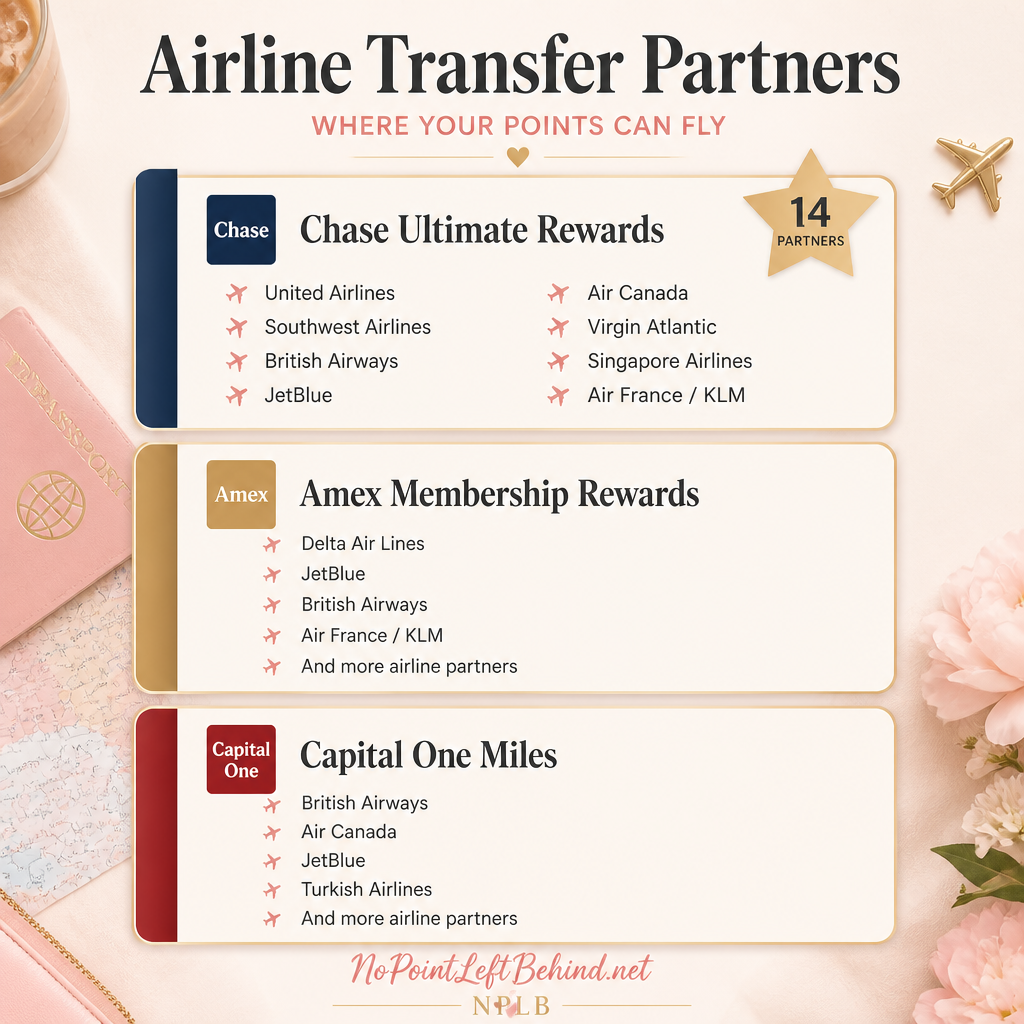
Notice how some airlines — like British Airways and JetBlue — show up across multiple programs? That gives you options. If you have points in more than one system, you can choose which bucket to pull from.
✈️ What I Do — How I Fly My Family Free
This is my thing. This is the strategy that changed our family's life. So let me give you the real talk.
I earn 20 to 30 free round-trip tickets every single year. Not just for me — for Brandon, for Tanner and Finn, for my parents, for my best friend. We've flown to Alaska, Europe, the Caribbean, and all over the United States without paying for tickets.
How? It's everything we've covered in this series, working together. The stacking (Days 3–4) earns a steady flow of points from our everyday spending. The sign-up bonuses (Day 5) pour in massive chunks — especially when I time applications strategically. And then I use those points — sometimes through the portal when it's quick and easy, sometimes through transfers when the value is incredible.
I've paid for exactly ONE plane ticket with cash since 2019. One. Tanner hopped on a trip at the last minute, and you know what? The cash price was so low that it actually made more sense to pay cash and save my points for a bigger redemption later. That's not a failure of the system — that's the system working. I had the points. I could have used them. But I made the strategic choice to hold them because I knew I'd get more value down the road.
THAT is thinking like a stacker.
Every other flight since 2019? Free. Hundreds of flights. Thousands of dollars in airfare we never paid. And it all started with the same steps you've been learning in this series — the same spending audit, the same card pairings, the same bonus strategy. The only difference between where you are today and where I am? Time. And you're about to have plenty of that.
Airline Cards vs. Transferable Points for Flights
On Day 9, we compared hotel-branded cards to transferable points cards. The same choice exists for flights — and the trade-offs are similar.
Airline Co-Branded Cards
These are cards tied to a specific airline — a Delta card, a United card, a Southwest card. Here's what they offer:
Earn miles only with that one airline
Great perks: free checked bags, priority boarding, companion passes, upgrade priority
Sign-up bonuses are often generous (50,000–80,000+ miles)
Best for: People who fly the same airline regularly and value the everyday perks
Transferable Points Cards
These are the cards we've been building our stacks around — Chase Sapphire Preferred, Capital One Venture, Amex Gold, and similar:
Points can be moved to many different airlines
More flexibility — book whichever airline has the best deal for each trip
Can combine points from multiple cards in the same ecosystem
Best for: People who are flexible about which airline they fly and want maximum options
Julie's Take
I lean heavily on transferable points because I don't fly one airline exclusively. I go wherever the deal is. But I know people who LOVE their airline card because they always fly the same carrier and the perks — free checked bags, priority boarding, companion certificates — save them real money every trip. Remember: there is no wrong or right way to do this. The cards that work for me might not be the best for you. The key is knowing your options so you can choose what fits YOUR travel style.
Pro Tips for Booking Free Flights
After 20+ years of doing this, I've picked up a few things that make a big difference. Here are my best tips for getting the most out of your points when booking flights:
Be flexible on dates. Award availability is MUCH better on weekdays and during off-peak travel times. If you can fly out on a Tuesday instead of a Friday, you'll find more seats and better value. Even shifting your trip by a day or two can open up options that weren't there before.
Book early. Popular routes fill up fast for award seats — especially during holidays and summer. If you know where you're going, start looking as soon as the airline opens up award availability for that date (usually 11–12 months out).
Check one-way awards. You don't have to fly the same airline in both directions. Sometimes mixing airlines — one carrier outbound, another for the return — gets you better availability and better value. Most programs let you book one-way awards.
Watch for transfer bonuses. Credit card issuers sometimes run promotions offering a 20–30% bonus on points transferred to specific airlines. That means your 50,000 points become 60,000 or 65,000 miles. These promotions pop up throughout the year — keep an eye out.
Set up fare alerts. Most airline loyalty programs let you set alerts for award availability on specific routes. Let the airline do the watching for you — you'll get an email when award seats open up on the flights you want.
Don't forget taxes and fees. Most award flights still have a small tax — usually $5–$50 for domestic flights, sometimes more for international. It's a tiny fraction of what the flight is worth, but budget for it so you're not surprised. A $5.60 fee on a $500 flight? I'll take that deal every single time.
📝 Today's Homework: The Dream Flight Comparison
Pick a trip you want to take. Anywhere. Dream big. Paris. Alaska. Grandma's house three states over. A beach you've been eyeing on Instagram. Wherever your heart says YES — pick that one.
Now do three things:
Cash Price: Go to Google Flights and look up what that flight costs in cash. Write it down.
Portal Price: Log into your credit card's travel portal and see how many points it would cost to book through the portal. Write that down too.
Transfer Price: This is the fun part — check if any of your card's airline transfer partners fly that route. Go to their loyalty program website and look up how many miles it costs through their award program. Write it down.
Now compare your three numbers: cash price, portal points, and transfer miles.
I bet the transfer option is going to make your jaw drop.
You don't have to book anything yet. Just start seeing the possibilities. Once you see a $500 flight available for 15,000 transferred points? You'll be hooked. This is the moment it all clicks — the moment you realize that every single point you've been stacking has a destination.
🔍 My Favorite Tool for Finding Award Flights: Point.me
Here's the honest truth — searching for award availability used to be a nightmare. You'd have to log in to each loyalty program one by one, search separately, and hope you found something. Point.me changed everything.
It's an award flight search engine that searches across multiple loyalty programs at the same time, so you can see all your options in one place — including which of your points currencies can book the flight. It's genuinely the tool I use myself, and for beginners booking their first award flight, it makes the whole process so much less overwhelming.
👉 Check it out at point.me
You don’t need this tool to book your first flight — it just makes the process easier. I still use it for searches after all these years!
What's Coming Tomorrow
We've covered free hotels (Day 9) and free flights (today). Your stack is earning points. Your bonuses are rolling in. You can see exactly how those points become real trips for your family.
Follow along: Join Travel Hacking Moms Group on Facebook for daily posts, live Q&A, and a community of moms who are stacking their way to free travel.
About the Author
Julie Davis has been travel hacking for over 20 years — long before anyone she knew was doing it. She's paid for exactly ONE plane ticket with cash since 2019 — her son Tanner hopped on a trip last minute and even though she had the points, it was cheaper to pay cash that one time. Every other flight? Free. Her family regularly earns 20–30 free round-trip tickets a year on points alone, plus countless hotel rooms. In 2024, she added casino cruises to her travel hacking playbook.
Julie loves traveling with her husband Brandon, her sons Tanner and Finn, her parents, and her best friends — because the best part of free travel is who you get to share it with.
She created No Point Left Behind (NoPointLeftBehind.net) to prove that travel hacking isn't complicated — it's just a skill nobody taught you yet.
Want to learn alongside thousands of other moms? Join Julie's free Facebook community, Travel Hacking Moms Group, where she shares real-time tips, wins, and answers your questions every day.
