Day 7: Credit Score Myths — The Truth About Your Number
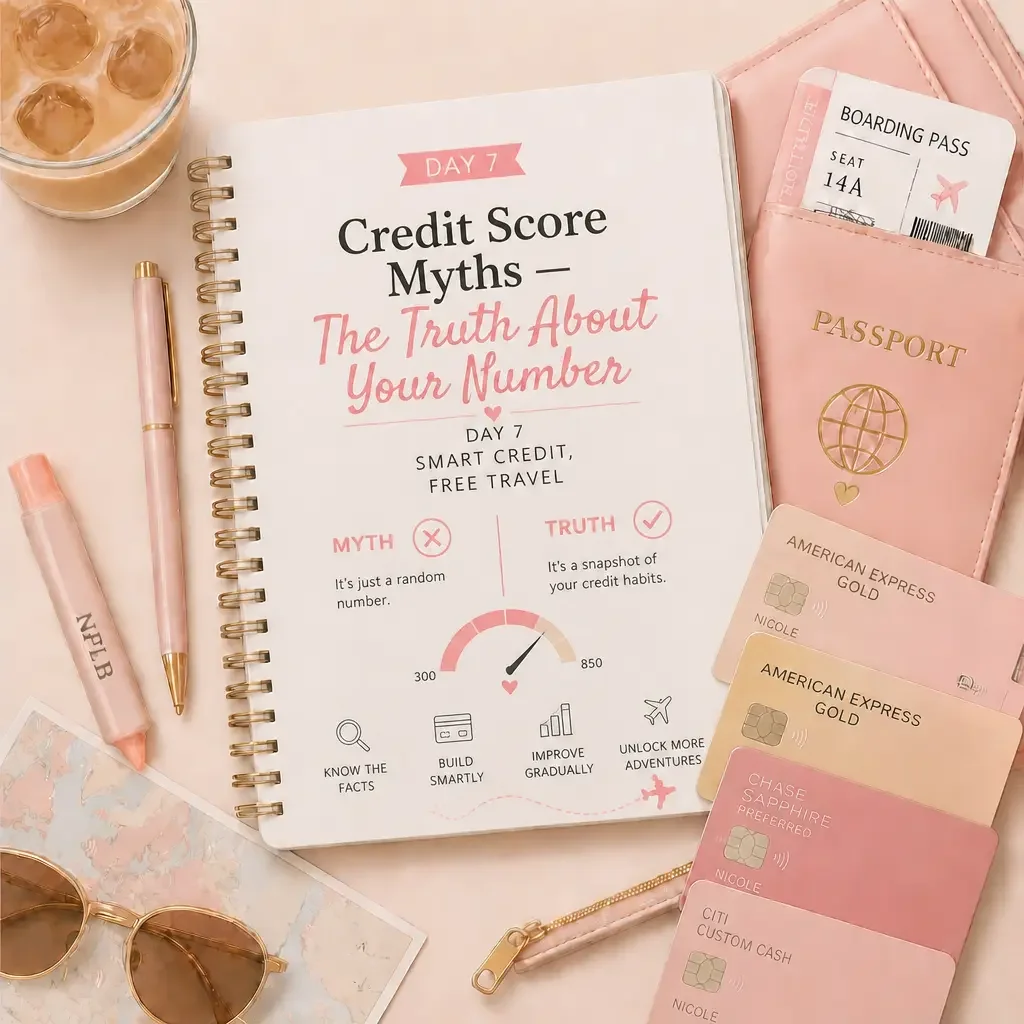
NPLB 14 Build Your Credit Card Line Up Series
"Won't all these cards hurt my credit score?" It's the #1 question I get. And the answer is going to surprise you.
By Julie Davis · NoPointLeftBehind.net · Day 7 of 14
I Know What You've Been Thinking All Week
We need to talk.
Over the past six days, I've asked you to do some pretty bold things. I've asked you to build a two-card stack. I've asked you to add a third card. I've asked you to chase sign-up bonuses and seriously consider applying for two or three new credit cards. And the whole time — I mean the whole time — there's been a little voice in the back of your head whispering:
"But what about my credit score?"
I hear you. I really hear you. This is the number one question I get from my community — more than questions about annual fees, more than questions about which card to pick, more than anything else. And it makes complete sense. Your credit score feels sacred. It feels fragile. It feels like one wrong move could unravel everything you've worked so hard to build.
Here's the thing: most of what people "know" about credit scores is wrong. Not a little wrong. Really wrong. And those myths? They are the single biggest thing keeping people from earning free travel for their families.
Today, we're going to bust those myths wide open. And by the end of this post, I think you're going to feel a lot better about your stacking strategy. You might even feel a little fired up.
Remember back in Day 4, when the FAQ section said "Won't having three cards hurt my credit score? Actually, having multiple cards can HELP your credit score"? I promised we'd dig into that in Day 7. Well — here we are. Let's do this.
First Things First: What Actually Makes Up Your Credit Score
Before we bust any myths, you need to understand how your credit score actually works. Your FICO score — the one most lenders use — is built from five factors. And the weight of each factor matters a lot.
Factor Weight What It Means
Payment History: 35%. Do you pay your bills on time? That's it. That's the whole thing. This is the single biggest factor in your score — by far
Credit Utilization30% How much of your available credit are you using? Lower is better. Experts generally recommend keeping it under 30%, and under 10% is ideal
Length of Credit History: 15%. How long have you had credit accounts open? Older accounts are better
Credit Mix 10% Having different types of credit — credit cards, a mortgage, a car loan, etc.
New Credit 10% Hard inquiries and recently opened accounts. This is the ONE factor people panic about.
Look at that table one more time. Really look at it.
The thing everyone worries about — opening new cards — is literally tied for the smallest piece of the pie at just 10%. The things that matter MOST — paying on time and keeping your utilization low — are things that credit card stacking actually helps with, not hurts. We'll get into exactly why in a minute.
Myth #1: "Opening New Cards Will Tank My Score"
This is the big one. The myth that stops people in their tracks. So let's address it head-on.
Yes, each time you apply for a new credit card, it creates what's called a hard inquiry on your credit report. And yes, a hard inquiry can affect your score. But here's what nobody tells you:
A hard inquiry typically takes fewer than 5 points off your FICO score.
Five points. That's it. And that tiny impact? It fades within a few months, even though the inquiry technically stays on your report for two years.
But here's where it gets really interesting. Think about what else happens when you open a new card: your total available credit goes UP. And when your available credit goes up, your credit utilization ratio goes DOWN. Utilization affects 30% of your score — that's six times more impactful than the inquiry.
So what actually happens for most people? A tiny temporary dip from the inquiry, followed by a potentially larger boost from lower utilization. The net effect is often neutral — or even positive — within a few months.
That little voice telling you to never apply for a new card? It's costing you free flights.
Myth #2: "More Cards = Lower Score"
I love busting this one because it's the exact opposite of the truth.
Remember what I said in Day 4? More cards equals more available credit equals a lower utilization ratio. Well, here's the proof: that lower utilization directly impacts 30% of your credit score — in a good way.
Let me give you a quick example:
You have one card with a $5,000 limit. You charge $2,000 a month. That's 40% utilization — too high.
You add two more cards, each with a $5,000 limit. Same $2,000 in spending. Now your utilization is $2,000 out of $15,000 — just 13%. That's a score-boosting number.
Same spending. Same habits. Dramatically different impact on your score — just because you have more available credit.
Here's something else people don't realize: people with the highest credit scores — 800 and above — often have seven or more credit accounts. It's not the number of cards that matters. It's how you use them. Low balances. On-time payments. That's the formula.
Myth #3: "I Should Close Cards I'm Not Using"
Please, please, please don't do this.
I know it feels responsible. It feels tidy. It feels like adulting. But closing a credit card you're not using is almost always the wrong move — and here's why.
When you close a card, two things happen that hurt your score:
First, your available credit drops. Less available credit means higher utilization. And we already know utilization makes up 30% of your score. Closing a card with a $10,000 limit doesn't make your debt disappear — it just makes your score think you're using more of your available credit than you actually are.
Second — and this one sneaks up on people — closing an old account can shorten your average credit history. Remember that "Length of Credit History" factor? It's 15% of your score. Your oldest accounts are doing quiet, important work just by existing. Closing one can knock years off your average account age overnight.
So what do you do with a card you're not using? Keep it open. Use it for one small recurring charge — a Netflix subscription, a tank of gas — and set it to autopay. Zero effort. Zero annual fee stress. And your score keeps the benefit of that available credit and account age.
The exception? If a card has a high annual fee that you genuinely can't justify, that's a different conversation. But a no-fee card collecting dust in your drawer? That card is working for you right now, even if you've forgotten it exists.
Myth #4: "My Score Has to Be Perfect Before I Apply for Anything"
This one breaks my heart a little because I hear it from people who have great credit. People with 720, 740, even 760 scores telling me they don't feel ready yet.
Here's the truth: most premium travel rewards cards want to see a score in the 670–700 range as a baseline. If you're above that, you are already in the game. You don't need an 800. You don't need to wait another year. You don't need to do anything special.
And remember — every month you wait is a month of points you're not earning. It's flights you're not booking. It's a family vacation that stays on the vision board instead of on the calendar.
Good credit isn't a destination. It's a tool. And right now, it's time to use it.
So What Does This Actually Mean for Your Stack?
Let's bring this back to where we started — your two or three card stack that you've been building this week.
Here's what your stacking strategy actually does to your credit score, in plain English:
Short term: A small, temporary dip from the hard inquiries. We're talking a few points. Maybe five, maybe ten if you applied for multiple cards close together. This is real, and I'm not going to pretend it isn't. But it is also completely, totally temporary.
Medium term (3–6 months): Your score starts to recover as the inquiries age. Your utilization drops because you now have more available credit. If you're paying your balances on time — which you absolutely are — your payment history is building beautifully.
Long term: Your score is often higher than it was before you started stacking. More available credit. More on-time payments. A growing credit history across multiple accounts. This is exactly why people with excellent credit often have more cards, not fewer.
The dip is the price of the ticket. The long-term boost is the flight you're taking for free.
The Real Talk Section (Because You Deserve It)
None of this works if you're carrying balances.
I have to be honest with you, because I respect you too much not to be. This entire strategy — the stacking, the sign-up bonuses, the points, all of it — is built on one non-negotiable foundation: you pay your balance in full every single month.
If you carry a balance and pay interest, the math falls apart. Credit card interest rates will wipe out the value of any points you earn, and then some. The points game only works for people who treat their credit card like a debit card — spend what you have, pay it off when the bill comes.
If you're in a season of life where carrying a balance is your reality, that's okay. There's no shame in that. But this strategy isn't for right now. Get the balance gone first, then come back. I'll be here.
For everyone else? Let's keep going.
Tomorrow on Day 8: Ecosystems — Why the Bank You Choose Matters as Much as the Card
Here's something most beginners don't realize: your points aren't just points. They live inside an ecosystem — a bank's entire rewards universe — and the ecosystem you build inside changes everything about what your points are worth and where they can take you.
Chase has one. Amex has one. Capital One has one. And they are not created equal.
Tomorrow we're breaking down the major credit card ecosystems, how they work, which ones are the most powerful for family travel, and how to decide which ecosystem — or ecosystems — you want to build your stack around.
This is the post that's going to make your whole strategy click into place. Don't skip it.
See you tomorrow. 👋
— Julie NoPointLeftBehind.net
