A quick note before we get into it: I'm not a financial advisor, and this isn't personalized financial advice. I'm just someone who's been using credit cards and playing the points-and-miles game for more than 20 years. I'm sharing what I do, why I do it, and what I've learned along the way. Your credit profile may look very different from mine, so what makes sense for me may not make sense for you.
Personal Referral Link Disclosure: I'm not a credit card affiliate. Any credit card links in this post are my personal referral links for cards I personally use or recommend. If you use one of my referral links, I may receive bonus points at no additional cost to you. Thank you for supporting No Point Left Behind.
A question popped up on TikTok recently after I mentioned canceling one of my Southwest credit cards:
Why didn't you downgrade it instead of canceling it?
It's a fair question. And honestly, it's exactly the kind of question I love because the answer isn't simply, always downgrade or never cancel a credit card.
I actually looked at my downgrade options before canceling. If Southwest had offered me a no-annual-fee option that made sense, I very well might have taken it.
But it didn't.
So I canceled the card.
And yes, I care a lot about my credit score. Mine has stayed above 800 for more than 20 years, even though I have canceled cards along the way.
Those two things can coexist.
The reason is that I don't make credit card decisions based on one talking point. I look at my entire credit picture and ask whether keeping that particular card still makes sense.
I Don't Believe "Never Cancel a Credit Card" Is a Universal Rule
Spend enough time in the credit card world and you'll hear certain pieces of advice repeated over and over.
One of them is:
Never cancel a credit card. Always downgrade it.
There's a reason people say it. Closing a card reduces the amount of available credit you have, which can affect your overall credit utilization.
But that doesn't mean the answer is automatically never close anything.
The question I care about is:
What does closing this particular card do to my particular credit profile?
That's very different.
I have a lot of credit cards. I have a long credit history. I also keep my balances and utilization in mind.
Someone with one or two credit cards and a relatively new credit history may come to a completely different conclusion than I do.
And I'd probably encourage them to.
👉 New to all of this? Start with my Beginner Credit Card Guide before worrying about advanced card strategies. The goal isn't to collect cards. It's to understand how credit works and build from there.
Meanwhile, I Have a Credit Card That's More Than 30 Years Old
Here's the part that probably explains my philosophy better than anything else.
I still have a no-annual-fee credit card that has been open for more than 30 years.
I use it about once a month.
It's not there because it has amazing travel perks. I'm not keeping it because there's an airport lounge involved. 😂
It's there because it costs me nothing to keep, I've had the account for decades, and I value that long credit relationship.
So I'm certainly not running around canceling credit cards without thinking about it.
But I'm also not willing to pay an annual fee forever simply because someone told me I should never close an account.
Those are two completely different situations.
That's Why I Told Finn His First Card Was His "Forever Card"
When my oldest son was ready for his first credit card, I approached his situation very differently from mine.
I suggested starting with the Chase Freedom Unlimited.
And I told him:
This is your forever card.
Use it. Pay it responsibly. Put something on it regularly. And value the credit relationship you're building with Chase.
I wasn't looking for the biggest signup bonus for him.
I wasn't trying to maximize every category.
I wasn't trying to teach him how to churn credit cards.
I wanted him to start with a solid no-annual-fee card that he could potentially still have decades from now.
That's the foundation.
The fun points-and-miles stuff can come later.
👉 Check out Chase Freedom Unlimited - my personal referral link
His Credit Card Strategy Shouldn't Look Like Mine Yet
This might be one of the most important things I've learned after doing this for so long.
Where you are in your credit journey matters.
I've been using credit cards strategically for more than 20 years. I have multiple cards, established credit relationships and a long credit history.
Finn is building his.
If he came to me with one or two credit cards and said, "I'm thinking about canceling my oldest no-annual-fee card," we'd be having a very different conversation.
That's why I'm careful when I talk about what I do.
You can look at What's In My Wallet and see quite a few cards. But that wallet wasn't built overnight.
Every card in there has a job. Some earn points. Some give me hotel benefits. Some give me travel protections or credits. And sometimes a card that once had a job stops earning its place.
That's when I reevaluate it.
Before I Cancel a Card, Here's What I'm Actually Thinking About
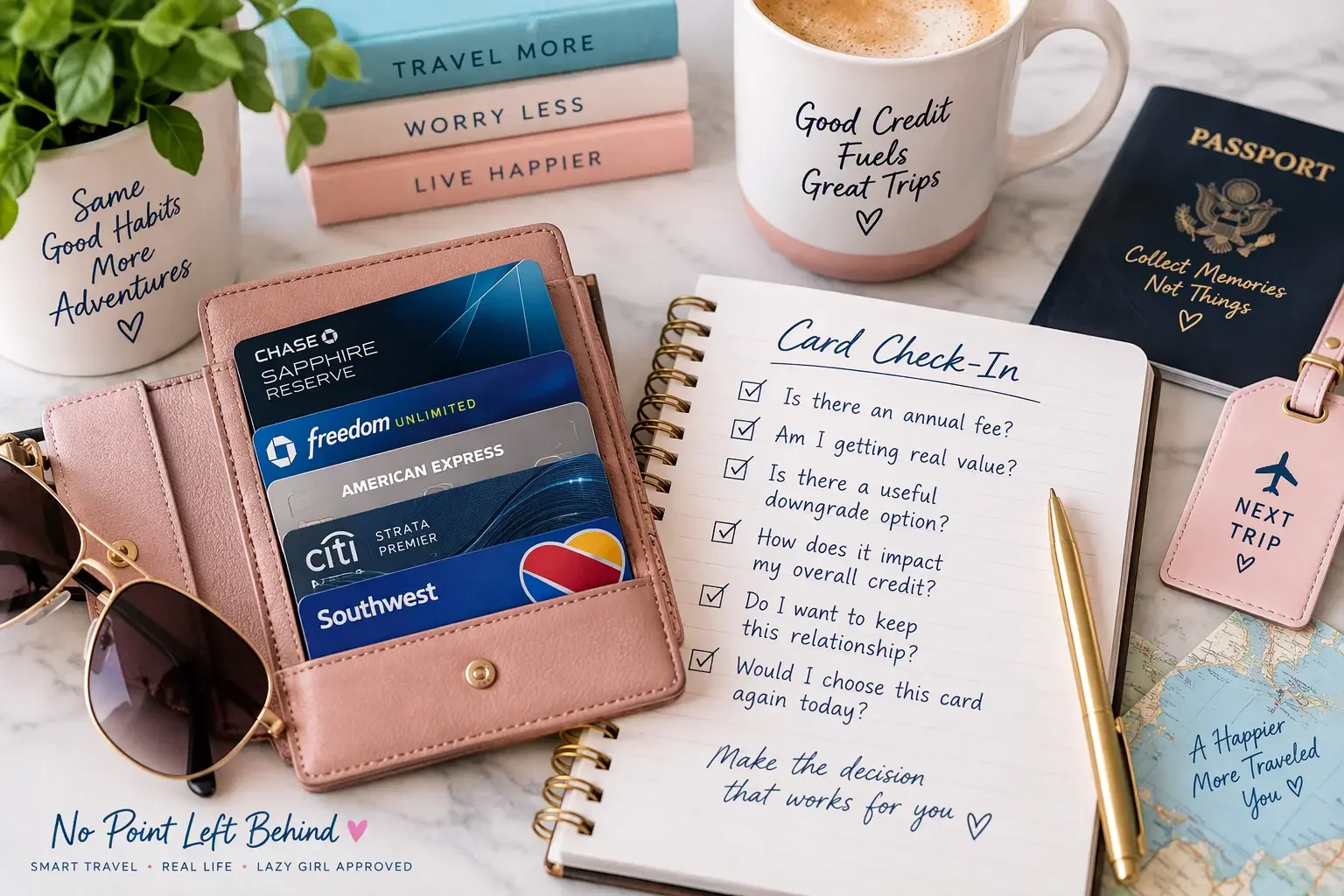
I'm not following a blanket rule. I'm looking at the bigger picture.
Does the card have an annual fee?
If it doesn't cost me anything to keep, that's a very different decision.
Am I still getting enough value from it?
I don't care that a card has $800 worth of benefits on paper if I'm naturally using $100 of them.
Is there a useful no-annual-fee downgrade option?
This is exactly what I explored with Southwest. If there had been an option that made sense for me, I might have done it.
What happens to my overall available credit if I close it?
One card disappearing from my credit profile may affect me very differently than it affects someone who only has two cards.
Is this an account or banking relationship I particularly want to preserve?
My 30+ year-old card is a perfect example.
And finally:
Would I choose this card again today?
That's one of my favorite questions for basically everything in my wallet.
Sometimes the Answer Really Is Cancel the Card
I think we sometimes get so caught up in maximizing points that we forget credit cards are supposed to work for us.
I'm not keeping an annual-fee card forever just so I can say I never cancel cards.
I'm also not canceling a 30-year-old no-annual-fee card because it isn't earning me enough travel points.
Context matters.
That's why, after 20 years of doing this, I'm perfectly comfortable looking at one card and saying:
You've served your purpose. It's time to go.
Meanwhile, another little no-fee card will probably still be sitting in my wallet when it's 40 years old.
And honestly? That's the part of credit card strategy I wish we talked about more.
Not just what's the rule?
But:
Why does the rule exist, and does it actually apply to my situation?
That's what I want you to learn here.
Because once you understand the why, you don't need TikTok, me, or anybody else telling you that you should always or never do something.
You can look at your own credit, your own wallet and your own goals and make an informed decision.
The Travel Hacking Tools I Actually Use
Credit cards are only one piece of how I travel. I've put together a list of my favorite travel-hacking tools, apps and resources that I actually use when I'm earning points, finding deals and planning trips.
👉 See My Favorite Travel Hacking Tools
You definitely don't need every travel tool out there. These are simply the ones that have earned a place in my own travel routine.
Keep Learning
If you're just starting out, don't try to copy my wallet. Start slowly and build the foundation first.
👉 Beginner Credit Card Guide: Start here if points, miles and credit card rewards are new to you.
👉 Credit Card Hub: My home base for beginner-friendly card guides, perks and real-life strategies.
👉 What's In My Wallet: See the cards I actually keep, how I use them and why they've earned their place.
And remember: the best credit card strategy isn't mine. It's the one that makes sense for your credit, your spending and your travel goals.
About the Author
Julie Davis is the creator of No Point Left Behind, where she shares the real-life points, miles and credit card strategies she uses to help her family travel more without making travel rewards a full-time job. She's been navigating credit cards and rewards for more than 20 years and has maintained an 800+ credit score while building a wallet that changes as her family's needs change. Her approach is simple: understand the why behind the strategy, use the benefits that fit your real life, and don't keep a card just because someone on the internet told you to.
